
The Challenge:
Climate change and environmental pollution are pressing challenges facing our society. A key issue is the high level of CO2 emissions resulting from the use of fossil resources, which contributes to global warming and endangers living conditions on our planet. It is therefore crucial to find innovative solutions to reduce CO2 emissions and manufacture products from renewable raw materials.
The Solution:
Biotechnological processes offer powerful solutions, particularly through the ability of microbes to utilize a wide range of renewable feedstocks.
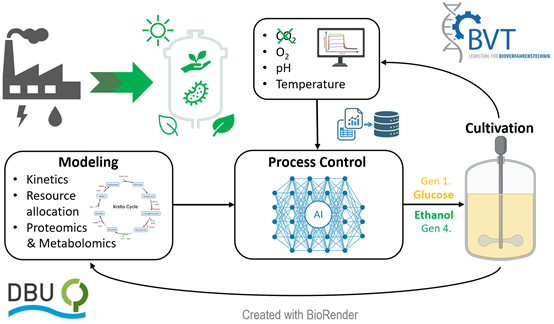
This project focuses on the sustainable, CO2-free production of fine chemicals – specifically mevalonate and PHB – trough the combined use of glucose and ethanol. Metabolically optimized strains of Corynebacterium glutamicum are used as biocatalysts. To gain a deep understanding of the complex intracellular processes, mathematical models are developed that integrate stoichiometric networks, co-substrate kinetics, and experimental multi-omics data obtained via UHPLC-mass spectrometry. Building on this, an AI-supported control system is being established: By fusing model predictions with real-time process data, the aim is to increase process efficiency and enable intelligent automation of the cultivation.
This project is funded by Deutsche Bundesstiftung Umwelt (DBU).
Stefan Straucher
Professorship for Systems Biotechnology
Research associates